
WEEK 10 - SMP PURCHASE
5 MAY 2018

3d print of a non-supported structure with fine vertical elements measuring 2mm in diameter.
A very exciting turning point in my research journey has been the finalisation of my SMP order (at long last!) this week. After much discussion with the supplier, SMP Technologies, Japan, I have ordered five reels of SMP filament costing close to AUD$1000. I was very impressed with their customer service, however I felt a minimum order of five reels was unnecessary, particularly in my case where my research thus far is conceptual – I’m unsure if this material will perform the way I require it to. The postage was also excessive, equating to almost a third of the total cost. Despite the monetary apprehensions I have now purchased the material that forms the basis of my entire Honours research and I’m very much looking forward to it arriving.
While I wait for the filament to arrive I have been 3d printing small scale models that all contain a component that could be of interest when printed with the SMP filament. For example, the image above shows thin arm-like structures that could potentially twist and bend yet remain fine and lightweight.
WEEK 11 - RESEARCH VIDEO
12 MAY 2018

SMP Artefact Concept 01 - Freestanding artefact with direct heat source
Next week is the screening of our research videos as part of the AAD HDR (Art, Architecture and Design Higher Degree Research) seminar program at UniSA. In preparation, I have written a script which I have recorded using a hired lapel microphone and digital SLR camera. The recorded sound didn't turn out as crisp as I would have liked but the voice is clear and I can't justify the hiring fee of another day of recording. Included in my final video are two concept animations depicting possible outcomes of my research. Each utilise the SMP 3d printing filament to create individual elements as well as a main heat source (in both cases electric lights). The concept shown above demonstrates the interactive element I would like to achieve in my final artefact. By making people part of the manipulation process this would give them a direct understand of how the material works and how it could potentially be applied in design outcomes.
In addition to preparing my video I have been working on my Research Proposal and have now finalised my Methods and Methodologies section. This has been a great exercise to, not only convey my intentions, but force me to consider each step of planning, making and testing I will need to undertake in the following months.
WEEK 12 - VIDEO SCREENING
17 MARCH 2018

Still from my final Research Video - A fern that contracts upon the touch of a human finger (CC Licenced).
Tuesday night was the screening of the AAD Honours Research videos on campus. I thoroughly enjoyed the evening, mainly because of the feedback we received from the HDR students and associated staff. We were able to see, first-hand, whether people understood our research and design intentions as well as learn where we could improve in areas of communication. After the session we were given the chance to ask the HDR students questions about their own study, work and research processes. I found this to be valuable information as, if I were to continue on with a PhD, I now know what to expect, not what is required on a submission level but the amount of time and effort expected when taking on research for 2-3 years.
I have also been working on completing my current research proposal ready to submit as a draft to my supervisor. After completing the video task I found the abstract and introduction of my proposal much easier to write. I feel that I have now reached a point where I understand the material and subsequently what I want to demonstrate with it. This being, interior space with elements that can be manipulated, formed and reformed instantaneously all to provide the user and designer further options when interacting with their environment.
WEEK 13 - SUBMISSIONS
26 MAY 2018
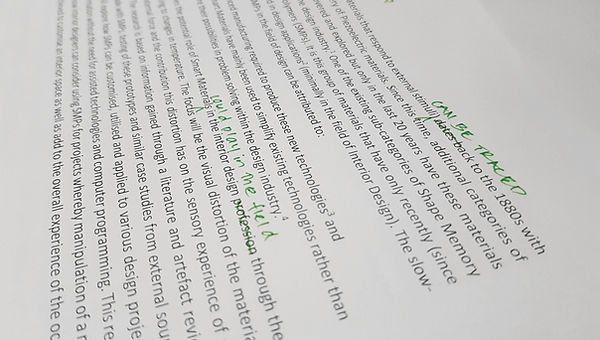
Temporary image - Research Proposal peer critique
As I reach the end of the academic semester, final submissions (for all classes) appear to creep up on me. Research Practices finished this week and it was, as I always find, nice to have the amount of overall work alleviated but also sad as a certain amount of energy and adrenaline comes to end. My final outcome for this subject was not only my video (as mentioned above) but the presentation of a mind map and 'family tree' exercises that I have been working on throughout the semester. I decided to publish and submit these documents in a bound folder as can be seen in this week's blog photo.
A class exercise undertaken in Research Methods this week involved the review of two peers' Research Proposal. I found this to be incredibly beneficial as it allowed me to gain feedback from other students on my written work. Key aspects we were advised to consider when reviewing each other's work included: whether the proposal was easy to follow, whether the assignment requirements were met and most importantly, whether the research intention was clear. The feedback I received was minimal but I followed up with questions. Overall, my peers expressed enthusiasm for my research, advised me that my writing was clear and succinct and that I had covered all aspects of my research intentions (including the testing stages of the SMP).